
6 Minute read
What Is AI in ERP – and Why It Matters in Manufacturing
Is your ERP system for manufacturing AI-enabled? If not, you could be missing out on huge benefits to help you manage, optimise and scale your operations...

Roger Teagle
22nd May 2026
Artificial Intelligence (AI) is rapidly becoming a core part of modern ERP systems, and for manufacturers, it’s changing how operations are managed, optimised, and scaled.
But what does AI in ERP actually mean in practice, and why is it so important?
What is AI in ERP?
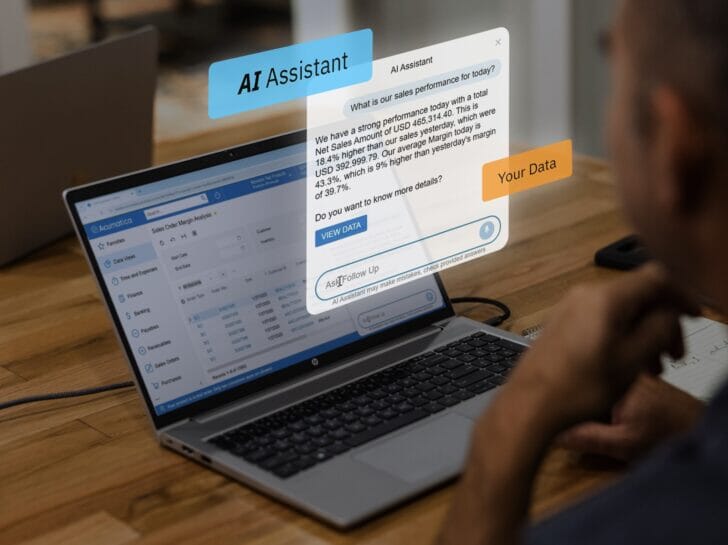
AI in ERP refers to the integration of technologies such as machine learning, natural language processing, and robotic process automation (RPA) into an ERP system.
In simple terms, it allows your ERP to move beyond just recording and reporting data to actively analysing it, learning from it, and helping you make better decisions.
From reactive to proactive insights
Traditional ERP systems are excellent at showing you what has already happened. AI takes this a step further by:
- Providing predictive insights based on historical data
- Identifying patterns, anomalies, and opportunities
- Recommending actions to improve performance
This shift – from reactive to proactive – is where the real value lies.
Automation that goes further
AI also enhances automation within ERP by handling both routine and complex processes, including:
- Data entry and document processing
- Invoice and purchase order management
- Inventory tracking and updates
- Workflow automation across departments
Rather than simply speeding up tasks, AI enables ERP systems to think, adapt, and optimise processes over time.
As highlighted in Acumatica’s AI strategy, the focus is on delivering ‘practical, embedded intelligence that integrates seamlessly into existing workflows and delivers real business value’. You can see more insights in the blog, Practical AI in ERP: Powerful Results.

“Acumatica’s CRM integration takes on new depth with AI built directly into the platform. Advanced features help sales and service teams act on insights rather than assumptions.”
Miten Mehta
Chief Engineering Officer at Acumatica
Why is AI important in ERP?
AI is important in ERP because it transforms the system from a back-office tool into a strategic driver of performance.
With AI embedded into ERP:
- Decisions are based on real-time, data-driven insights
- Processes become more efficient and less reliant on manual input
- Businesses can anticipate challenges instead of reacting to them
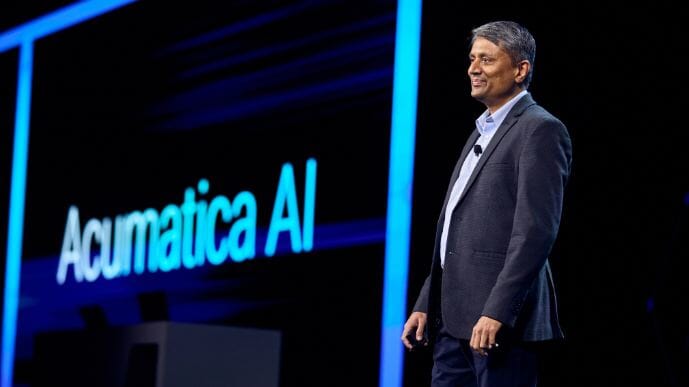
Acumatica’s latest AI-enabled product release (2026 R1) reinforces this shift – embedding intelligence directly into workflows so businesses can act faster, with greater accuracy and confidence.
Why Is AI important in manufacturing?
For manufacturing businesses, the impact of AI in ERP is particularly significant. Manufacturers operate in complex environments, balancing production schedules, supply chains, quality control, and cost pressures. AI helps bring these moving parts together in a more intelligent, connected way.
Increased efficiency and productivity
AI automates repetitive, time-consuming tasks, freeing up your team to focus on higher-value activities.
It can also analyse production data to:
- Identify bottlenecks
- Suggest process improvements
- Streamline operations
This leads to faster production cycles and reduced human error.
Improved quality control
AI-powered tools such as computer vision can monitor products in real time, ensuring quality standards are met at every stage.
By identifying defects early, you can:
- Reduce waste
- Prevent faulty products progressing further down the line
- Maintain consistent quality
Optimised supply chain
AI enables smarter supply chain management by analysing multiple data points, including:
- Supplier lead times
- Transport routes
- Demand patterns
This allows you to:
- Optimise inventory levels
- Avoid shortages or overstocking
- Respond proactively to disruptions
Predictive maintenance
Instead of relying on fixed maintenance schedules, AI uses real-time data to predict when equipment is likely to fail.
This means:
- Maintenance is carried out only when needed
- Unexpected downtime is reduced
- Equipment lifespan is extended
Better demand forecasting
AI improves forecasting accuracy by analysing customer behaviour and market trends.
For manufacturers, this results in:
- More accurate production planning
- Reduced excess inventory
- Lower operational costs
Key benefits of AI in manufacturing ERP
AI integration delivers measurable outcomes across manufacturing operations. Here’s where we see the biggest impact:
Forecasting, inventory, and supply chain management
AI enhances demand forecasting by analysing trends, seasonality, and external signals with greater precision. It continuously learns from data, adjusting inventory levels and replenishment automatically.
This ensures production stays aligned with demand, while reducing waste and cost.
Predictive maintenance and quality control
AI-powered ERP systems monitor equipment performance in real time, identifying issues before they lead to failure.
At the same time, intelligent quality control tools detect defects early, protecting both output quality and operational efficiency.
Intelligent scheduling and real-time decision support
AI-driven ERP systems can dynamically adjust production schedules based on:
- Machine availability
- Workforce capacity
- Supply chain changes
Real-time insights allow you to respond quickly, minimise disruption, and maintain delivery performance.
Process automation, safety, and compliance
AI enhances automation by:
- Reducing manual data entry and errors
- Triggering workflows automatically
- Monitoring shop floor conditions for safety risks
It also supports compliance by logging processes and ensuring regulatory requirements are consistently met.
AI in ERP: from theory to practical value
One of the biggest shifts we’re seeing – particularly with platforms like Acumatica – is a move away from ‘AI for AI’s sake’ towards practical, usable innovation.
AI is being embedded directly into ERP systems in ways that:
- Solve real operational challenges
- Integrate seamlessly into existing processes
- Deliver immediate, measurable value
As Acumatica puts it, the goal is not just what AI can do, but what businesses can achieve with it.

Where to start with AI in ERP
For many manufacturers, the question isn’t if AI should be part of ERP, but how to get started.
If you’re exploring AI, it’s worth assessing:
- How well your data is structured and accessible
- Where automation could deliver the biggest impact
- Whether your current ERP system can support AI capabilities
You can explore this further in Acumatica’s AI readiness checklist.
And for a deeper dive into how AI is shaping ERP, Acumatica’s handbook is also a useful resource, Preparing for AI-Driven Growth.
Is your ERP AI-enabled?
AI is no longer a future concept – it’s becoming a fundamental part of how modern ERP systems operate.
For manufacturers, this means moving from reactive processes to intelligent, proactive operations, with better visibility, greater efficiency, and stronger control across the business.
As AI continues to evolve, those who adopt it early – within the right ERP framework – will be best positioned to scale, compete, and grow with confidence.
We can help you to identify where AI would make the most difference to your business. To discuss how to enable AI within your current ERP systems, contact us for an initial discovery call.